Photosynthetic Sloths of Amazonia
a mere ¶ from One River by Wade Davis!
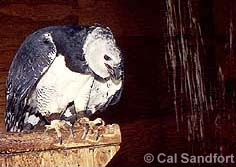
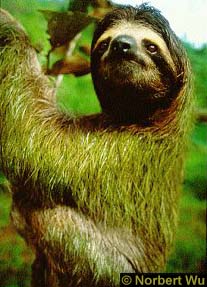 The three-toed sloth is a gentle herbivore. Its slow movements, together with its cryptic coloration, protect it from its major predator, the harpy eagle.
Viewed up close, the sloth appears as a hallucination, an ecosystem unto itself that softly vibrates with hundreds of exoparasites.

A dozen varieties of arthropods burrow beneath its fur; a single sloth weighing a mere ten pounds may be home to over a thousand beetles. The life cycles of these insects are completely tied to the daily round of the sloth. With its excruciatingly slow metabolism, the sloth defacates only once a week.
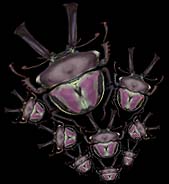 of the tree, voids its feces, and then returns back up. Mites, beetles, and even a few species of moth leap off the sloth, deposit an egg in the dung, and climb back onto their host for a ride up the tree. The eggs germinate, and in one way or another, the young insects find another sloth to call home.
The answer provides an important clue to the immense complexity and subtlety of the Amazonian ecosystem. Biologists have suggested that in depositing feces at the base, the sloth enhances the nutrient regime of the host tree. That such a small amount of nitrogenous material might actually make a difference suggests that this cornucopia of life is far more fragile than it appears.  Why would this animal go down to the base of the tree, exposing itself to all forms of terrestrial predation, when it could just as easily deficate from the treetops?
Wade Davis, One River
Explorations and Discoveries in the Amazon Rain Forest
|
| ||||
 |
|
|
|
|
|
| ||||

e a r t h m
a n i f e s
t a t i o n

